Becoming Human by Zakiyyah Iman Jackson
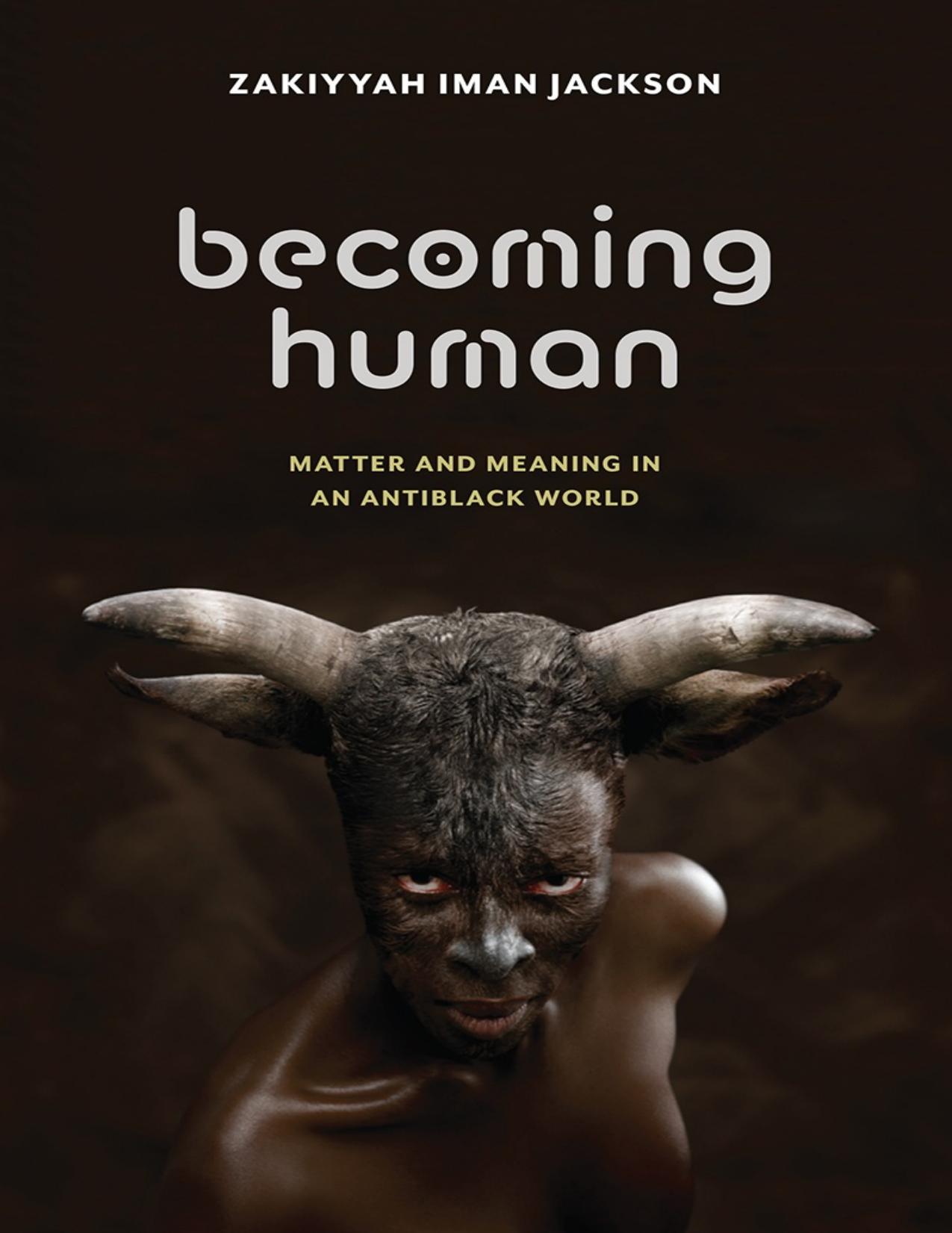
Author:Zakiyyah Iman Jackson [Jackson, Zakiyyah Iman]
Language: eng
Format: epub, pdf
Tags: LIT004040 Literary Criticism / American / African American
Publisher: New York University Press
4
Organs of War
Measurement and Ecologies of Dematerialization in the Works of Wangechi Mutu and Audre Lorde
Is a metaphysics of race more or less serious than a naturalism or biologism of race?
—Jacques Derrida, Of Spirit
I felt the battle lines being drawn up in my own body.
—Audre Lorde, A Burst of Light
Gendered and sexual imperial discourses on “the black female body” provided the conditions of possibility for the historical emergence of the generic construction of “the animal”—a term elastic enough to include humans and nonhumans. The transcultural adoption of our current hegemonic and specifically biocentric conception of “the human,” in its distinction from “the animal” as defined in the onto-teleological terms of natural science and philosophy, articulated black female abjection, in particular, as a prerequisite of human qualification in the newly conceived globalizing terms that occasioned “Discovery.” This history’s preoccupation with sexual difference and maternity is often evoked by a Latin phrase: partus sequitur ventrem (delivery follows the womb). But as I will show, this could just as easily be evoked by contemporary racial reproductive health inequity.
I demonstrate that racism not only posits cleavages in womanhood such that black womanhood is made to be a gender apart, an other gender, but also that antiblackness itself is sexuating, whereby so-called biological sex is modulated by “culture.” In other words, at the registers of both sign and matter, antiblackness produces differential biocultural effects of gender and sex. Such a frame raises the stakes of recent feminist materialism’s inquiry into both the inter(intra)actional relations of discursivity and materiality as well as the gendered politics of hylomorphism, or the form-matter distinction. Thus, antiblack formulations of gender and sexuality are actually essential rather than subsidiary to the metaphysical figuration of matter, objects, and animals that recent critical theory hopes to dislodge.
The operations of racialized sexuation and maternity are essential to what Giorgio Agamben calls the “anthropological machine,” or the recursive attempt to adjudicate, dichotomize, hierarchize, and stage a conflict between “the human” and “the animal.” Agamben stresses that while it is commonly and devastatingly exteriorized, this conflict is first and foremost a conflict within Man. While Agamben fails to do so, we might name this conflict within Man: race. Yet, the ordering of nonhuman nature is also not reducible to a demand for racial hierarchy, as the domination of environs and nonhuman forms of life was a privileged expression of conquest as well. Neither “race” nor “species” is merely symptomatic, but rather they are contiguous and interdependent. To make matters more confusing, this abutting is often the case at the register of semantics. As Darwin would state in Descent of Man, “race” and “species” are virtually synonymous and thus parsing “race’s” heteroglossia or various meanings is perhaps only perceptible by its contextual appearances.
The final chapter of Becoming Human concerns the interrelation of scientific and philosophical discourses of race and species as well as continues the previous chapter’s investigation of mutation, speculating on both its potentiality pernicious and vitalizing force by examining figurations of the black female body in genetics, evolutionary discourse, and works by Audre Lorde and Wangechi Mutu.
Download
This site does not store any files on its server. We only index and link to content provided by other sites. Please contact the content providers to delete copyright contents if any and email us, we'll remove relevant links or contents immediately.
| Anthropology | Archaeology |
| Philosophy | Politics & Government |
| Social Sciences | Sociology |
| Women's Studies |
Cecilia; Or, Memoirs of an Heiress — Volume 1 by Fanny Burney(32558)
The Great Music City by Andrea Baker(32018)
Cecilia; Or, Memoirs of an Heiress — Volume 2 by Fanny Burney(31956)
Cecilia; Or, Memoirs of an Heiress — Volume 3 by Fanny Burney(31941)
We're Going to Need More Wine by Gabrielle Union(19046)
All the Missing Girls by Megan Miranda(16026)
Pimp by Iceberg Slim(14506)
For the Love of Europe by Rick Steves(14121)
Bombshells: Glamour Girls of a Lifetime by Sullivan Steve(14075)
Talking to Strangers by Malcolm Gladwell(13370)
Norse Mythology by Gaiman Neil(13363)
Fifty Shades Freed by E L James(13240)
Mindhunter: Inside the FBI's Elite Serial Crime Unit by John E. Douglas & Mark Olshaker(9342)
Crazy Rich Asians by Kevin Kwan(9292)
The Lost Art of Listening by Michael P. Nichols(7506)
Enlightenment Now: The Case for Reason, Science, Humanism, and Progress by Steven Pinker(7313)
The Four Agreements by Don Miguel Ruiz(6765)
Bad Blood by John Carreyrou(6621)
Weapons of Math Destruction by Cathy O'Neil(6279)
